
Etchings
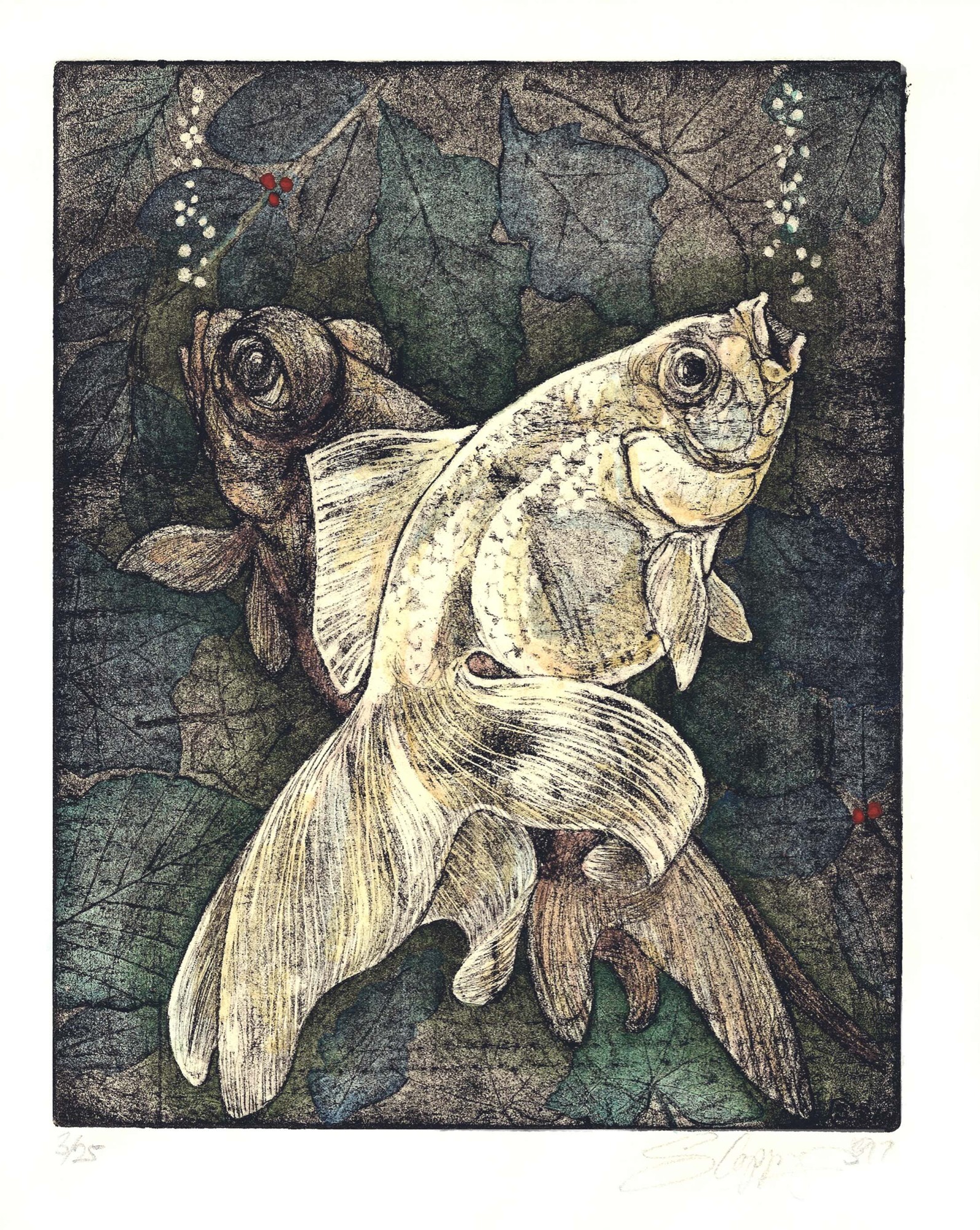
It was a great pleasure to return to etching in 1995 after a gap of nearly twenty years. Over the next five years I built up a portfolio of over a hundred editioned plates - ranging from sketchbook work to intricate double-bite, hand coloured and a la poupee prints.
There is huge satisfaction in such a process based form of drawing. You start with a scrappy looking sketch which, taken through a number of techniques, provides you with the opportunity to select, improve and develop an image.
TWO GOOD FISHES is an example of combining different ways of using the process.
ETCHING is an ancient ‘intaglio’ print-making technique, meaning that the paper receives the ink from the incised lines and not from the surface of the plate.
An Intaglio print can be normally recognised by the plate mark and by the fact that the ink stands up from the paper in a very slight relief, which can be often detected by touch.
This etching was produced using the ‘soft ground’ method:
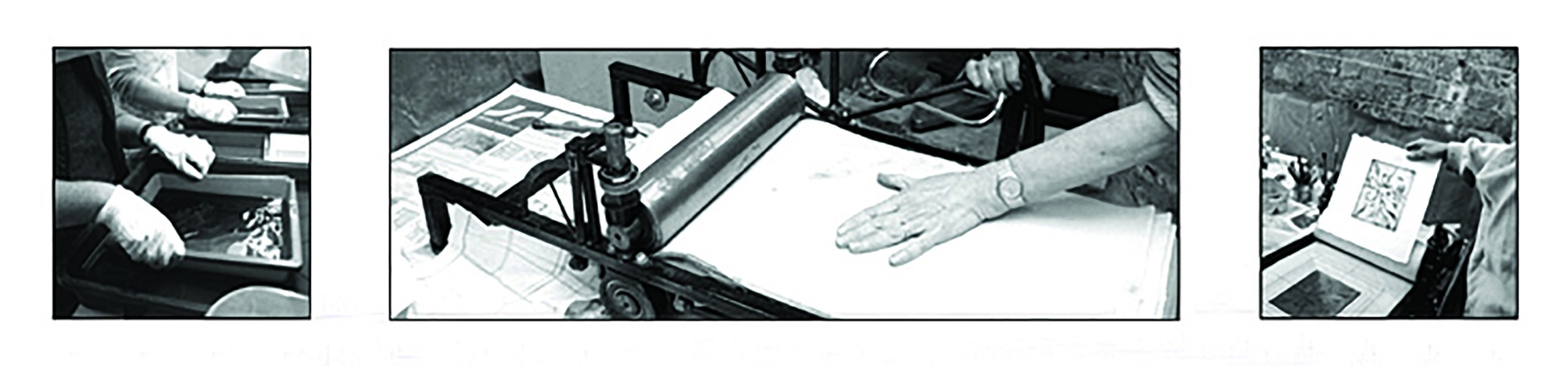
A wax ‘ground’ is rolled onto the surface of a metal plate, (in this case copper). The image is drawn directly on the plate through tissue paper. When the tissue is pulled off, the plate is then submersed in a bath of Ferric Chloride. Where the drawn lines have exposed the bare metal, the chemical is allowed to ‘bite’ lines or texture into the copper.
The ink is pressed into the lines with a pad called a "dabber", and wiped off the top surface with muslin or scrim.
Damp etching paper is laid onto the inked plate. A print is taken by passing the plate and paper together through a roller press. The pressure must be strong enough to force the damp paper into the lines and lift the ink out onto the paper.
A number of etchings can be printed in this way - the number is set initially by the size of the edition.
TWO GOOD FISHES: First the plate was ground, drawn, bitten, and printed. Then the plate was ground again, leaves were arranged and pressed onto the ground, after which the plate was re-bitten and printed again to achieve the affect of the fish swimming in foliage. When you look closely it is not clear whether they are in the water or not.
The coloured prints are made in one of two ways:
The first, HAND COLOURED, is achieved simply by painting a print with watercolour.
The other method is known as A LA POUPEE. This is a technique by which two or more colors are applied to a single plate, usually by finger, cotton buds or rolled up scrim. Each inking enables the artist to print one copy only. Complex prints can take hours to print each time.
Most of the etchings you see are drawn from life, directly onto the plate. They are printed in the studio, the edition sizes are fairly small, and each print is more or less unique.
Etch v. from the German word, atsen, meaning to eat or corrode, a process by which an image is eaten into metal by acid through a waxy coat, for the purpose of printing from it.
The etching process as applied to printmaking is believed to have been invented by Daniel Hopfer (circa 1470-1536) of Augsburg, Germany. Hopfer was a craftsman who decorated armour in this way, and applied the method to printmaking, using iron plates (many of which are still extant).
PRINTING TERMS:
Hand-colouring - literally painted with watercolour onto the individual print.
A la Poupee - Intaglio technique by which two or more colors are applied to a single plate, usually by finger, cotton buds or rolled up scrim. Each inking enables the artist to print one copy only.
Bon a tirer (BAT) - The ‘right to print’ proof, designated by the artists, against which all others are to match.
Cancellation Proof - Proof from a defaced or marked plate, block, or stone to indicate the end of an edition.
Chine colle - Technique for attaching thin pieces of colored paper to the larter printing paper, when put through the press, the inked image prints on both sheets.
Chop - Embossed mark of a printer, publisher, artist, or collector on the edge of a print.